Why 2026 Is Peak Digicam
The short version: phone cameras got so good that a perfect photo stopped meaning anything, and AI image generation made "looks real" a claim nobody trusts by default. A flash-blown, slightly soft, obviously-a-cheap-camera photo now carries information a flawless one doesn't: someone was there, it happened, nobody fixed it afterward.
The photo got perfect and nobody wanted it
A modern phone doesn't take a picture so much as reconstruct one. It fires a burst, aligns the frames, picks the sharpest regions, lifts the shadows, tames the highlights, smooths skin, sharpens eyes, and hands you a composite of several moments that never existed as a single instant.
The result is technically extraordinary and emotionally flat. Everything is evenly lit. Nothing is blown out. Your dim, chaotic, red-lit bar looks like a well-lit room. The photo is objectively better and it tells you less about what the night felt like.
Then AI made "flawless" suspicious
The second thing happened fast. Once a convincing photo of anything could be produced without a camera, the visual markers of quality — perfect lighting, tack-sharp detail, ideal composition — stopped reading as skill and started reading as possibly synthetic.
Imperfection inverted its meaning. A hard direct flash that nukes the foreground, a slightly missed focus, an ugly white balance shift, visible sensor noise — these now read as evidence. Nobody generates a mediocre photo on purpose, which is exactly why a mediocre photo feels honest.
What the digicam look actually is
Strip the nostalgia and the aesthetic is a specific set of technical failures from 1999–2005 point-and-shoots:
- Hard on-camera flash. No diffusion, no bounce, no clever multi-frame exposure. Faces go bright, backgrounds fall to black, and there's a hot spot wherever the light hit first.
- White balance that guessed and lost. Everything indoors goes warm or oddly green. Nobody corrected it because nobody could.
- Tiny sensor, low resolution. Soft detail, visible noise in shadows, and a compression pattern that turns fine texture into mush.
- One exposure, no bracketing. The camera picked wrong sometimes, and you kept the photo anyway.
Every one of those is a defect. Together they're the most recognizable photographic style of the last thirty years. Full technical breakdown in our Y2K filter guide.
Why the revival keeps going instead of peaking and dying
Most aesthetic revivals burn out in about eighteen months. This one hasn't, and the reason is that it's not really about the 2000s. It's about wanting photos that look like they were taken rather than produced.
That desire doesn't go away as long as the default keeps getting more processed — and it will. Every phone generation adds more computational cleanup. Every year the gap between "what a phone gives you" and "what the room looked like" widens. The digicam look is the pressure valve.
There's also a social component nobody talks about enough: a hard-flash photo is flattering in a different currency. It doesn't make you look airbrushed, it makes you look like you were having a good time. Those are different compliments and a lot of people would rather have the second one.
The reason to fake it instead of buying one
The obvious move is to buy an actual 2003 camera, and plenty of people have — which is why a $30 point-and-shoot now goes for $200 on resale. But the real cameras have real problems: no charger, a dead proprietary battery, a CompactFlash card, no way to get the photos off, and a two-second shutter lag that means you miss the moment you were trying to keep.
The look was never in the hardware. It's in the flash characteristic, the white balance error, the resolution ceiling and the compression. All of that can be applied to a modern sensor, live, before you press the shutter — so you get the aesthetic and the shot.
How to get it on the phone you already have
- Get Y2K Cam free and open the camera.
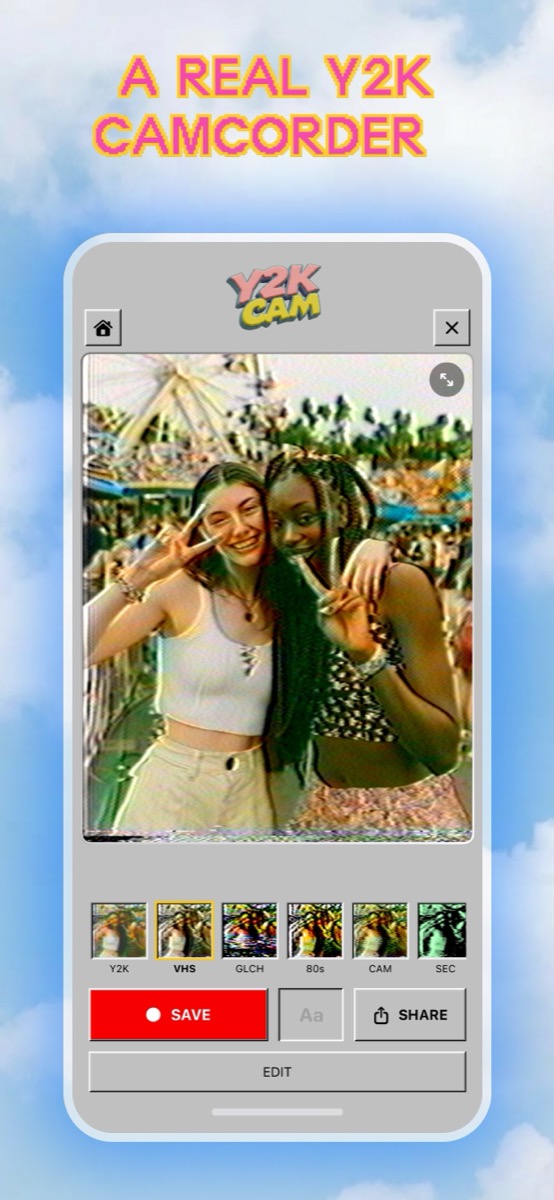
- Pick the Y2K look — the 1999 point-and-shoot flash rendering. You see it live in the viewfinder, so you frame for the blown-out flash instead of fixing it after.
- Shoot indoors, at night, close. The look needs the flash to do work. Bright daylight is the one condition where it reads as nothing.
- Dial the intensity. Tap the selected filter for the clean↔heavy slider. Subtle is more convincing than maxed out; keep it at the point where it looks like a bad camera, not a filter.
- Burn in the date stamp if you want the full artifact. It's the single fastest signal that a photo isn't from this decade.
- Or convert your camera roll — import existing photos and they come out looking like they were shot on a 2-megapixel sensor.
iPhone · iOS 17+ · works on photos and videos